TrackCast: Forecasting Object Motion as Full-Surface 3D Point Tracks

Department of Computer Science, University of Oxford

TrackCast forecasts the full-surface 3D motion of an object from a short history of context images.

Abstract

Anticipating how objects move is a fundamental capability of visual intelligence. Point tracks describe this motion independently of appearance, but most point-track forecasters either predict 2D trajectories of in-view pixels or lift those pixels to 3D with per-pixel depths. They track pixels, not objects, and therefore forecast only the visible part of an object's surface. We introduce the task of full-surface 3D point-track forecasting: predicting the future 3D tracks of every point on an object's surface, seen and unseen, from a short history of frames. These tracks cover the whole object, so they can be expressed in an object-centric canonical space. To leverage this, we present TrackCast, a flow-matching diffusion transformer that takes the tracks reconstructed from the context frames and forecasts every track jointly in the canonical space, which captures the object's deformation, and in world space, which captures its global motion. It can be conditioned on how much the object moves in world space and deforms in canonical space. Since no real-world dataset provides such tracks for training, we build an automatic pipeline that extracts them from in-the-wild videos, and release AiM-Track, over 7k full-surface track sequences of animals. On three animal datasets and on robotic manipulation of deformable objects, TrackCast forecasts deformation more accurately than state-of-the-art 3D forecasters trained on the same full-surface tracks.
Full-Surface Track Forecasting

Choose a method above the viewer and an animal below it; drag the view to look from any angle.

Method

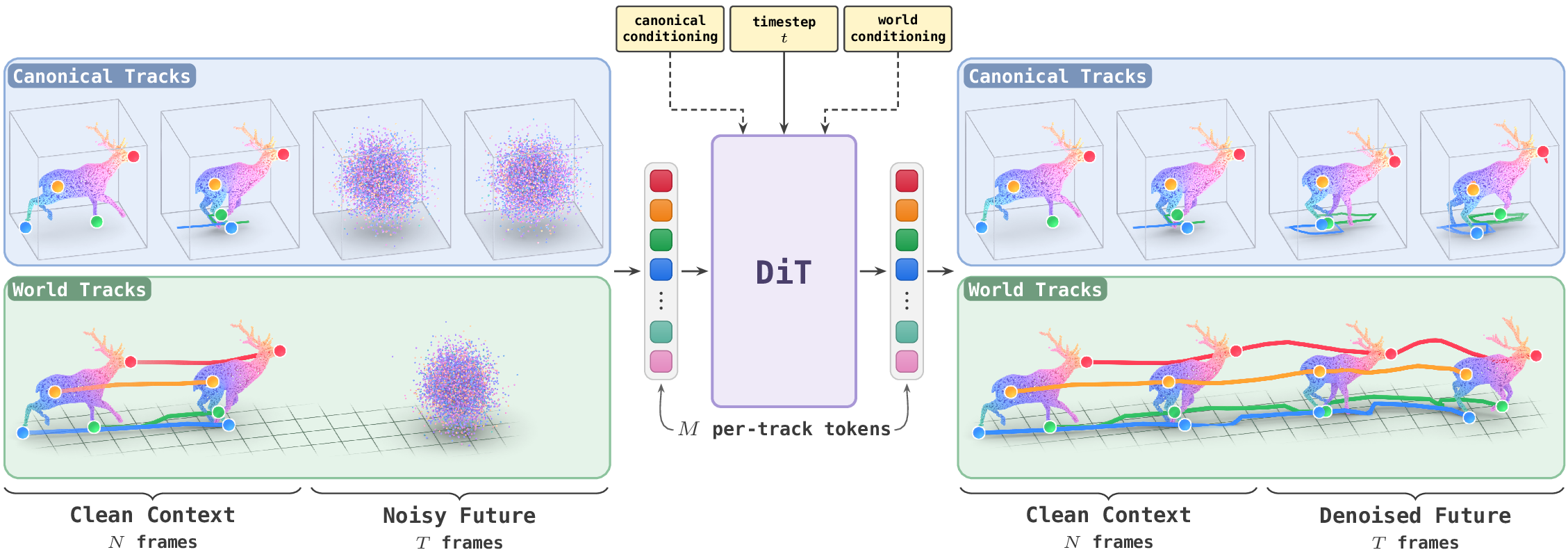
TrackCast forecasts an object's motion as M full-surface 3D point tracks, each expressed in two spaces: an object-centric canonical space that isolates deformation, and a world space that adds rigid motion. One token per track holds its clean context and noisy future in both spaces, and a diffusion transformer (DiT) jointly denoises both futures by flow matching. The DiT can optionally be conditioned on world and canonical motion magnitudes, which control how much the object moves and how much it deforms.

Method overview: the canonical and world tracks, each with a clean context and a noisy future, enter a diffusion transformer as one token per track, together with the timestep and the optional canonical and world conditioning; the transformer returns the denoised future in both spaces.

The AiM-Track Dataset

We release AiM-Track, a dataset for training and evaluating full-surface 3D point-track forecasting: over 7k sequences of full-surface tracks, extracted automatically from in-the-wild animal videos. Each example shows an input video and its tracks from a different view.

Controllable Forecasts

TrackCast can be conditioned on two values: how much the animal moves in the world, and how much its body deforms in its own canonical frame. Together, the two values select a behavior. For this animated tiger, the map shows the behavior at each pair of values (world, canonical), and the forecasts at the three marked pairs are on the right.

Tiger model: “Tiger attack eat v01” by shahabahmed, CC BY 4.0.

Robotic Manipulation

Forecasts on held-out DROID videos. Left: TrackCast and PointWorld, both without action conditioning, next to the ground truth. Right: from the same context, a higher canonical conditioning makes the TrackCast forecast less rigid.

BibTeX

@article{lin2026trackcast,
  title   = {TrackCast: Forecasting Object Motion as Full-Surface 3D Point Tracks},
  author  = {Lin, Jacob and Weber, Simon and Clark, Ronald},
  journal = {arXiv preprint},
  year    = {2026}
}